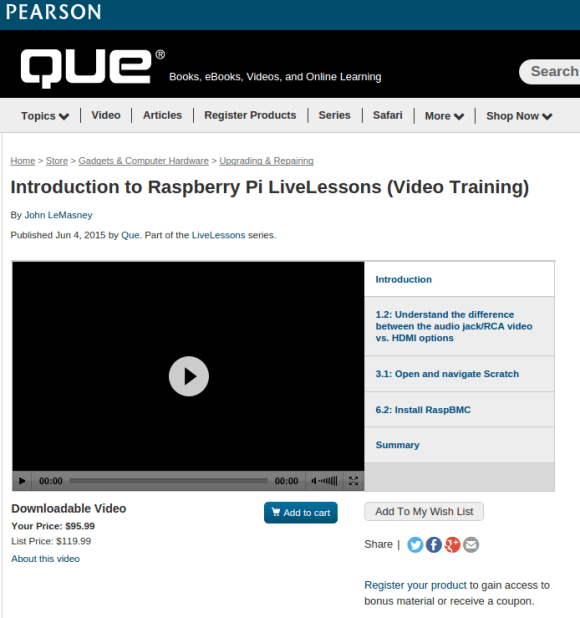
Introduction to Raspberry Pi LiveLessons Video Training Que – http://goo.gl/dzID3i
I made some videos earlier this year.
I had the great pleasure earlier this year of working with Que Publishing to develop and release several video how to products about WordPress and Raspberry Pi. You can see some samples here: I really enjoyed the experience of walking to the studio in San Francisco. The air was so warm, and the food was so very good and fresh. It made it a joy to work in the studio and come out into the bright sunshine.
I loved it. It wasn’t until recently that I had an opportunity to reflect on my experience, and it was really healing. Thanks to Que and Pearson for the professionalism and gratitude that I was shown in that process. It was a delight to get to know all of you.
“John LeMasney is a designer, artist, writer, poet, technologist, consultant, open web advocate and open source evangelist. He is most interested in helping people to use technology to make their lives, work, and world better.” found in John LeMasney | Que at http://goo.gl/dzID3i
TechArts is going to make a song, and share how they did it.
Technology and the Arts, my longest running podcast with the multi-talented Brian Kelley, is trying something different. We are making a song together, and sharing the process as we go. We are not sure what kind of song it will be, or what it will sound like. But we just recently locked down the tempo, agreeing on 80 BPM. We have also decided on Audiotool, the amazing cloud based EDM workstation. Some other details are revealed in the first two episodes of this season. all about making a song, collaboratively, remotely, and electronically.
Please watch below and subscribe on YouTube (links in the descriptions)!
“Streamed live on Sep 14, 2015 John LeMasney and Brian Kelley return for another season of Technology and the Arts – this time, they’ll take you behind the scenes of the creative process as they plan to collaborate on a music project.” found in Technology and the Arts – Ep. 75 (9.14.2015) – YouTube at https://goo.gl/92IdeF
“Streamed live on Sep 23, 2015 John LeMasney and Brian Kelley return for another episode of Technology and the Arts, as they continue to take you behind the scenes of the creative process of a collaborative music project.” found in Technology and the Arts – Ep. 76 (9.23.2015) – YouTube at https://goo.gl/v16Fwn
Of particular interest in episode 76 is a very brief overview of Audiotool, Audacity, and Drumbit, the tools we will be using to make our song.
I volunteer to take part and present in classroom interactive sessions arranged by Nepris.com. It is mostly with grade and high schools who want to talk with experts on a particular topic. I’m honored to do the work. This morning, I had the opportunity to answer the following interview questions via video chat with Stephanie Edmiston’s class in BENTON MIDDLE SCHOOL, BOSSIER PARISH via Nepris. Here’s the session description:
“Students enjoy learning about careers from people who are in the field. They like to understand how they can get on a career path and greatly appreciate practical insights and advice.” – View Session | Nepris – https://app.nepris.com/#!sessions/view/36551
Since I was going to answer these questions live, I decided to write out my answers beforehand to think about my logic, and so I’d be able to share the answers with you.
Also, Nepris was kind enough to share the video with me, so here is the video as well.
27 Interview questions for John LeMasney about being a technology consultant.
1. For an information technology/cyber security related career, what paths, opportunities, and/or strengths should the student identify or focus on?
JL: Mathematics, observational skills, and Linux. Also, try to understand every detail of knowledge contained in some thing. It can be anything: flowers, food, language. Be the most dedicated enthusiast of something, and know it through and through. Mine is Inkscape.
2. What is the job outlook in the information technology/cyber security field?
JL: Increasing exponentially. Internet of things, Cyber attacks nationally and internationally, Sony, etc.
3. How did you become interested in this field?
JL: I first caught the bug in a class in college where we were in a computer lab. I wanted desperately to be a computer lab tech for the classroom. I wanted to help people to know what I knew about computers and technology. It excited me, and I spent the rest of my life doing that.
4. Did you know you were going to do this job when you were a teenager?
JL: Not really, but I was an early enthusiast. I learned Basic on a TI99-4A at 12, basically at the urging and influence of my mother (sensing the increasing importance of technology), and I fell in love with technology in waves throughout my life.
5. What is your educational background?
JL: I have a Bachelor’s of Fine Art in Sculpture, and a Master’s in Organizational Leadership with a focus on Communications. I am a lifelong learner. People tend to find my Degrees odd, in that there are not technology degrees there. My knowledge about technology comes from my passion for it. My degrees helped with understanding creativity and organizations, and I use those skills every day in my technology work.
6. What types of courses do you recommend for high school students?
JL: Science, Technology, Engineering, Arts, and Math. (STEAM)
7. Did you find any clubs or extra-curricular activities especially helpful?
JL: I find the rise in robotics teams and Makerspaces to be amazingly helpful. There are often computer enthusiast clubs, and lots of opportunities to learn about making and hacking. We are having a Princeton Hackathon to help solve civic problems like potholes with tools like Arduino. The entire community is welcome to learn to hack.
8. Is an advanced degree essential to career success in this field?
JL: No, though I find that pursuing higher levels of knowledge to be very common among hackers. Hackers are often lifelong learners.
9. What skills are the most important to acquire in this field?
JL: Learn and practice open source code. Learn everything you can about the ways that code works, which you can do with open source projects. Then, use it in unexpected ways. Figure out the essence of what makes code work, and you can be a stellar computer security specialist or technologist.
10. What professional organizations should students join to be successful in this field?
JL: Join Maker groups and find Makerspaces in your area, often in libraries. Look for Linux Users Groups (LUGs) and Computer Users Groups (CUGs), and find topics to present on.
11. Your consulting practice covers a wide range of services. What is your primary focus, and what are your major job responsibilities?
JL: My primary focus is Web Development, and my job responsibilities include Server Management (Apache, MySQL), Service Management (WordPress, Drupal), Graphic Design (Inkscape), Branding (a marketing imprint), and Customer Service (how can I help you?).
12. Do you work with other people, on a team, or by yourself?
JL: All of the above. I am an individual consultant, with my business. I work alone a lot, or in co-working spaces, like my library, because it often leads to new connections or re-connections with colleagues and clients. I often pair or team up with people for short-term or long-term projects. I just had dinner with the team for TEDxCarnegieLake, in which I was the technologist on staff. I also teach at several local libraries, schools, and universities, all of whom have people I have to work with to arrange times, space issues, technology infrastructure, etc. I recently worked with the technology staff of a local school district to migrate to Google Apps for Education, all of whom knew most of what I knew.
13. What is your typical day like?
JL: I start at about 9 am, and often go until 2 am. My life and work float in and out of each other, which keeps things interesting. If I have meetings that day, I usually arrange them in places near each other to keep travel down, and often between 10-12 or 2-4. I have some luxury with my meals, which is nice, because I love to cook and I’m a foodie. Also, I will often reward myself with a nice walk if I’m keeping up with projects. The work-life balance of a consultant can be very rewarding. I usually keep coding work for late at night, when it’s quiet, and I can focus. But it’s hard to describe a typical day, as I don’t often have two days alike.
14. What are the greatest challenges and rewards of your position?
JL: The greatest challenge, by far, is keeping a steady income and managing it. In the work that I did in Academia as an Instructional technologist, there was a check that came every month. Now, I get lots of checks, but all with relatively small amounts compared to a 9-5 job. There are a lot of $125 checks that have to come in to add up to a $40,000 salary.
The greatest reward by a mile, is flexibility. If I don’t want to work today, and can afford to take a break, I do. No demerits, no excuses, no concerns. If I want to go take a walk because it is an amazingly beautiful day, I do. It would take a hard, hard year to make me want the 9-5 schedule back.
15. Do you travel in your work?
JL: I travel a lot! I travel every week to NYC, Princeton. Philadelphia, Cherry Hill, Bucks County, Trenton, and other local areas for work. However, I visited (with gratis travel) to LA, San Francisco, Washington DC, Maryland, and Chicago since January. I really do not enjoy driving, but I do get to listen to my favorite podcasts, like All About Android, and This Week in Google.
16. Can you work from home some or part of the time?
JL: I work from home most of the time, unless I am meeting a client, or presenting. There are days where I work all day from home, and never leave.
17. Are there any health hazards in this profession?
JL: Generally speaking, not really. I encountered a lot more danger in my time as an artist with chemicals and solvents and tools. There is a lot of driving, and the issues that go with that. I guess inhaling solder fumes or getting electrocuted, maybe? There are a lot of amps in a power supply.
18. How would you describe the culture of your workplace?
19. What is a common myth or misconception about your job?
JL: I am often surprised at how often truly brilliant people marvel at what I know about technology. I think that people think that it is a special kind of knowledge, but it’s only as special as 1000 other expertise areas, like cooking or gardening or fishing or selling, all of which have an amazing depth and breadth to explore. The myth is that technology is especially difficult to learn or know deeply comparative to any other expertise worth diving into. .
20. Contrast the role of an independent consultant with employment in a large company.
JL: I’ve done both. In a large company, you are a cog. I am not using the term negatively. You might be a very important cog that keeps the mill running, but at the end of the day, you are a small part of a large machine. As an independent consultant, you are the entire machine connecting to cogs of other machines.
21. What do you enjoy most about your job?
JL: It’s a toss-up between waking up when I want and the pride that I feel in my work.
22. Can you describe related jobs in your field of work which might also be of interest to the students?
JL: System Administrator, Emerging Technologist, App developer.
23. What type of student work or internship experience would employers look for in a job applicant?
JL: Library, volunteer, tutor, study abroad, web development intern. At least that’s what I would look for. In all honesty, the interview is most important, and it’s the answers you can give to problems they have more so than anything else. If you can describe how to solve a problem the employer didn’t know they were having, that’s impressive. Security expert applicants should find holes in the systems of their potential employers and demonstrate them in interview. I’d hire that person.
24. How did you locate the right people to help you along the path to a successful career?
JL: I have no earthly idea. My best explanation is that I made myself available, offered to volunteer, and put myself in contact with ‘hubs’, people who enjoy connecting people. The person who launched my independent consultant career asked me to speak at a library about technology, and that is when everything changed as far as considering technology as an independent consultant. She ended up creating hundreds of connections for me, including many other hubs, and I will be forever grateful. Her name is Janie Hermann, she is at the Princeton Public Library, and she is a force to be reckoned with. She and other members of the library recently won an award for programming at PPL from NJLA. #Libraries have become incredibly important to my work, mostly because of Janie.
25. What type of compensation range and benefits should students expect in this industry?
JL: As a technologist or manager at a university, expect between 50-90 unless you pursue administrative positions, which can be 120,000 or more. As an independent consultant, expect more like 40-60 for a few years. Develop a business plan if you want to be an independent consultant. Know your expenses through and through.
26. In this field, is it more common to be paid by a predetermined consultant fee, sales commission, or salary?
JL: I don’t know anyone in my industry who works on commission. We are often selling ourselves or selling an idea and executing it, but not for commission. 🙂 Technologists in organizations are often salaried. I work on a rate that varies according to the client. Here’s my Rate and Policy Doc: https://docs.google.com/document/d/1trir4rpKcTeK0xBWZcEPbE9cGcv6S5ycB18yEK36-5Y/pub?embedded=true
27. What is the most important piece of advice you would give to someone going into this career field?
JL: Treat people well. Treat people with kindness and dignity and truth. Learn everything you can and then give that knowledge away as freely as you can. Become a source of joy for the people you work with. Laugh every day.
Venn diagram of nutritional management by lemasney
My Weekly ‘Therapy’ Session
Venn diagram of nutritional management (three gauges) by lemasney
I was having a conversation with a very good friend the other day. We were talking about the circle of topics that we always talk about, e.g. life, work, relationships, status, and emotion. I deeply enjoy the conversations and they happen almost weekly. It is my own surrogate for therapy, and we pay each other by giving that listening and suggestion to each other in response.
At any rate, it was his turn on the couch, so to speak, and he was telling me that he had no outlooks, no drive, very little to show for his effort, and little to look forward to. He said that he was waiting for things to happen, and did not care much when they did. This is atypical for my friend, usually a bastion of insight and support for when I feel this way.
In discussing possible solutions, we talked about the Invisible Hand theory, often applied in financial theory, in which some people believe that we are acted upon by an unseen influence, like fate, or God. At the opposite extreme, there is a free-will mentality, in which we put ourselves on paths that lead to a greater or lesser likelihood of intended outcomes. I am in the self-driven free-will camp.
For instance, let’s say that we are talking about an accident. It happens. Was it fate that caused the accident, in which we had no choice in the matter, and it was going to happen no matter what? Or was it you taking the risk of that accident by getting into the car or driving recklessly? All other possibilities and contingencies aside, you likely feel stronger about one, or the other.
Some might say that we are born into the understanding capability that we have. That we are more likely or less likely to have the ability to be smart about some particular topic, because of fate or destiny. This is often attributed to me in regards to technology. Some say I ‘just get it’ because it was meant to be that way. My point of view is that I understand technology because I have a passion for it, and want to learn about it, I want to have it in my hand, and I want very much to understand it. To this end, I surround myself with people, media, practices, and work that moves me towards that end. It is not an effort, per se, because I have a passion for it, but it is not by fate, in my opinion. I choose that particular path.
Nutrition, Emotion, and Schedule
51 of 365 on meeting management by John LeMasney via lemasney.com
We also talked about it in regards to nutrition. I lost over 100 pounds in about a year after being obese most of my life. This happened because I read books, got tools, and practiced, to that end. I did not know what I was eating, what I was burning, or how any of it worked. I spent time with people who thought nothing of eating footlong sandwiches and chips or fries for breakfast, lunch, and dinner. I did not put the right foods in my refrigerator, did not visit the right restaurants, and did not understand the hidden natures of food, such as how food’s size or type or connotation (e.g. ‘healthy’) is completely unrelated to satiation, calories. or flavor.
In regards to emotion, the same is true. Without meditation to understand the nature of your mood, or by spending time with negative or poisonous influences, you might be asking for a bad mood. You might not see patterns and relationships between food, visits, actions, tone, and mood, but they exist. Unless it’s just fate, but I do not believe that it is.
Finally, there is schedule. I, myself, live by my calendar. I use tools like IFTTT to place an event on my calendar automatically when I get or make a phone call, and record all of the details that I can in the fields of meetings, such as an address in the location field, so that later, I can review and understand the nature of the way that I spent my time, which may very well affect how I spend my time better.
Insights on Tools and Quantification
Towards the end of the conversation, I had a very good insight. For me personally, it is the tools that allow me to review and annotate the quantification of events related to food, schedule, safety, and communication. Like almost anything else I believe and understand the truth of something when I can sense (sight, hearing, taste…) it. I realized that it is because of my awareness of incoming calories in MyFitnessPal combined with output of calories in FitBit that I am able to easily maintain, increase, or decrease my weight. I realized that it is because of the manual and automated manipulation of my schedule that I can see very clearly what took place yesterday, tomorrow, last week, next week, last year or next year.
It is because of the automated download of on-demand media such as technology podcasts about topics I find important in my work that I am able to stay abreast of what is going on in those arenas. By making good choices in the grocery store, I am forced to some degree to make good choices about eating.
I figure that if I can find the right tool for the other concerns in my life, such as money or customer relations, I might be able to apply the same kinds of logic to those in order to make those ecosystems better as well. My emotion, for example, is now being recorded every three hours by MoodiModo, an emotion tracking app that asks me about 16 likert style questions (are you more or less…) about my moods like how angry, scared, or anxious I am. I can look at the charted responses in conjunction with my food diary, exercise charts, or calendar in order to see trends between, let’s say, food or meetings and my level of anger or joy and maybe begin to sense causal relationships.
His response? “But that takes willpower and commitment in order to do that, you have that.”
My response? “if you leave the right tools and choices in your path, working passively and automatically, you need neither. “
Wrapping text around an object in Inkscape by lemasney
This video demonstrates how to use Inkscape to disguise a soup can’s label, and then to wrap text around it fairly believably. Here is the final image.
Wrapping text around an object in Inkscape by lemasney