What do I love about Inkscape? Why am I sharing it? I am committing myself to making one new video a week as part of a series. Each one will explore a different topic that I love, and hopefully effectively convey what I love about it. If you like them, please give them a thumbs-up on YouTube! If you like the series, go ahead and subscribe to the playlist on YouTube for more!
“Learn how to design your own original waveform tattoo with Inkscape, Audacity, and Linux! In this, the first of 52 planned videos for 2016, John LeMasney starts off the “What I love about…” series with a true love of his: Inkscape, the open source vector illustration application. Think Illustrator, but free as in freedom. In order to show his love, he’s going to share how to make your voice into a tattoo using free software like Ubuntu, Inkscape, and Audacity. It’s a fun time, and it would not be the same without you. Music: Chorale Prelude ‘Machs mit mir, Gott, nach deiner Güt’, BWV 957 (Bach, 1880)” found in What I love about… Inkscape! – YouTube at
About LeMasney Consulting
I want to help people. I typically do this in regards to technology, productivity, or living, but I like talking with people about just about anything. If you think I might be able to help you, please contact me at lemasney@gmail.com or 609 553 9498. I’d love to either help you directly, or help you to get the help that you need – lemasney@gmail.com. Try me!
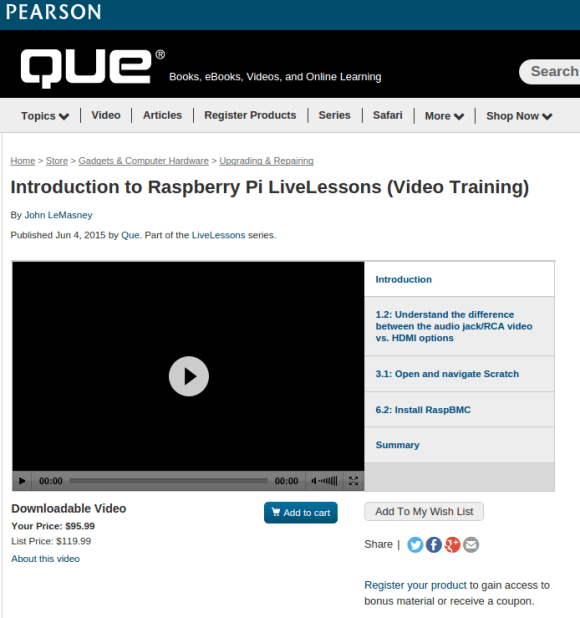
Introduction to Raspberry Pi LiveLessons Video Training Que – http://goo.gl/dzID3i
I made some videos earlier this year.
I had the great pleasure earlier this year of working with Que Publishing to develop and release several video how to products about WordPress and Raspberry Pi. You can see some samples here: I really enjoyed the experience of walking to the studio in San Francisco. The air was so warm, and the food was so very good and fresh. It made it a joy to work in the studio and come out into the bright sunshine.
I loved it. It wasn’t until recently that I had an opportunity to reflect on my experience, and it was really healing. Thanks to Que and Pearson for the professionalism and gratitude that I was shown in that process. It was a delight to get to know all of you.
“John LeMasney is a designer, artist, writer, poet, technologist, consultant, open web advocate and open source evangelist. He is most interested in helping people to use technology to make their lives, work, and world better.” found in John LeMasney | Que at http://goo.gl/dzID3i
I was made aware of this event that took place on October 14th, 2015 through a friend, and am incredibly glad that she shared it with me. She had no idea when she suggested it how excited I would get. Shepard Fairey, a brilliant and rule-breaking graphic designer, well-known progressive, and street artist famous for his Obey Giant brand, the Obama Hope posters, and the Andre the Giant has a Posse stickers, was going to be talking about my most revered and personally influential artist, Jasper Johns, most famous for his flags, targets, numbers (all everyday objects and ideas), and his major impact in the Modernist Pop movement that followed and extended Abstract Expressionism.
I had to teach a class at the same time. However, as I thought about it, I decided to reschedule the class, as I found this to be a truly unique possibility: To hear one hero speak about another hero.
On Open Source.
The talk was in the Great Stair Hall of the Philadelphia Museum of Art, and I got there especially early. Graciously, the event was free with admission (pay as you wish) and so all were truly welcomed. Upon approaching the venue, there was a table set up for the sponsoring organization, Open Source. Knowing something (ahem) about the topic of open source in software and hardware, I was amazed at the synchronicity of the idea, the art, the speaker, and the topic of the evening. Open Source in Philly is a month long cooperative art project by The City of Philadelphia Mural Arts program. More details here:
“In 2015, the City of Philadelphia will become an Open Source space, including: An EXHIBITION of 14 new public artworks, created and on display throughout Philadelphia A CENTRAL VENUE, open for dialogue with staff, participating artists, and the curator, featuring photo and video documentation of the project, plus interactive displays for the public A variety of TOURS, including docent-led trolley and walking tours between sites, as well as audio guides and maps for self-guided visitors Months of PROGRAMMING, leading up to and throughout October 2015, including a major launch party, artist and curator Q&As, lectures, talks, film screenings, hands-on workshops for families, and other exciting events co-led with partnering organizations around Philadelphia” found in About — OPEN SOURCE at
On Fairey’s self-denied expertise in Johns.
Fairey opened by talking about his audience being mostly composed of people for whom Art History was not a major topic of study. He did not do this in anything like a disrespectful way, but rather as a way to talk about the way that he hopes that his followers might be introduced in a venn diagrammatic way to the fine arts as well. He said that he was wrongly described as an expert in Jasper Johns, and while I’m sure there are many who know the deepest depths of the theory and application and processes of his work, I’d argue that few know more about the intent of Johns’ work than Fairey. He made this self-evident in the way that he spoke of Johns’ history, reasoning, influence of the art ecosystem, and agency given to artists due to Johns.
On their shared geography.
I was surprised and amazed to find out that Fairey had recently had a cooperative exhibition with Johns in their common home of South Carolina. He also noted that few other well-known contemporary artists came from there, and that Johns’ move to NYC was one particular difference in their trajectories. I loved the way that geography seemed so important to Faireys recognition of their commonality, and made me think of my roots in PA and then NJ, and how that has influenced me.
“”The Insistent Image: Recurrent Motifs in the Art of Shepard Fairey and Jasper Johns” presents Fairey’s latest series of works about the energy industry and the environment, alongside a selection of prints by fellow South Carolina native Jasper Johns. Both artists return again and again to certain symbols and motifs — flags and targets being a theme shared by both artists. Yet the two artists could not be more different in the communication of their message. Where Johns cultivates ambiguity and answers no questions, Fairey’s work is pointed and exclamatory. Both artists have cultivated a personal language of patterns that run through their respective bodies of work.” found in Shepard Fairey Returns to South Carolina Hometown for City-Wide Art Show – Hollywood Reporter at http://goo.gl/8A6cmZ
On the presence of Johns in Fairey’s work.
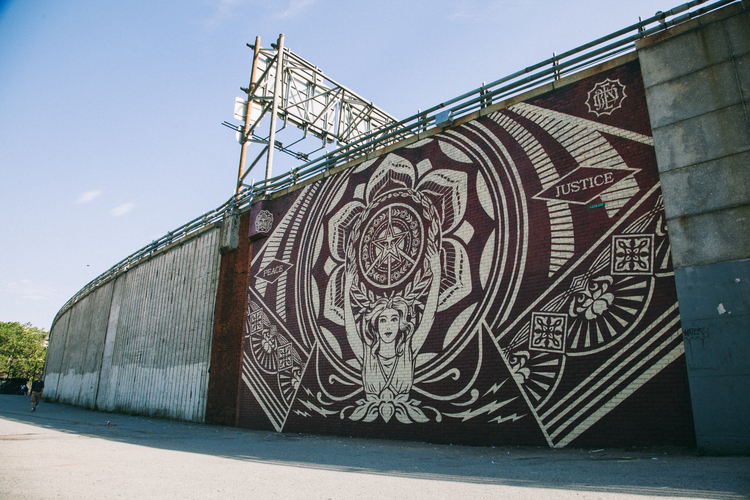
“Shepard Fairey’s 2010 mural on Houston and Bowery in New York” found in Love 2 Hate Shepard Fairey! | Banksy’s Girlfriend at http://goo.gl/XSNqrF
Fairey showed a lot of his own work, though I do not remember seeing any of Johns’ work in his slidedeck. He started by showing a series of prints of a tilted American Flag that became a central motif of work about the new state of America, and what the flag represents to others around the globe. He of course was paying homage to Johns’ work using the American flag, but noted that the flag would have been seen differently when Johns did it, before it was a mandated statement of solidarity used via lapel pins. Fairey makes masterful use of symbols and symbology, and this is in fact what I have always loved about Johns’ work as well. Flags, arrows, targets, repetition, numbers, and text are all used in Fairey’s work (according to him, but now obviously so), in homage to Johns.
On the concept of street art in museums.
At the end of his talk there was an odd Q&A where the only questions allowed to be asked had already been asked via Twitter a week before. Points off for this, PMA. I had questions, and the live, present audience should have the opportunity to participate. No one even knows if those people who asked the questions were even in the room. However, one question that was asked was one that I loved the answer to. The question was about how Fairey felt about the transition of Street Art to galleries and museums. Fairey’s answer was right on: The two things are different. Once the art leaves the street, it is no longer street art. The actual street art is still in the street.
Beautifully planned, well executed, and a night I will remember personally for a long time to come.
Sweetgum Seed lamp (detail), steel, glass, and LEDs, Robert Kuster and John LeMasney, 2015
There’s a lot going on now at LeMasney Consulting!
Teaching
John LeMasney teaching
Teaching at area schools and libraries has started up again! I’m at Rider University, Princeton Adult School, Princeton Public Library and other great venues and old friends like Cherry Hill Public Library. I’m talking about visual literacy, graphic design, personal branding, Arduino & Raspberry Pi, the Internet of Things, and lots of other fun topics. You can see all of my public events on the calendar in the sidebar or menu.
I’m doing a lot of WordPress work now in helping some local entrepreneurs get off the ground, developing branding campaigns, and strategizing about new avenues. A lot of people are really excited about one-page designs, but I’m not totally sold on their longevity. Call me and tell me your take on it.
I’m still very excited about the Photo Essay about Jedediah Higgins House though I’d love more people to see it. Have you checked it out yet? <blink> I’ve also been thinking alot about the social networking problem of chaos versus order, and how hashtags are a really great, open solution that many people are still confused about. Hashtags are an idea, simply, that collect other ideas. When I precede a word with a hash (#) it indicates that I am using it as a collector, group, or thread that leads to other content about that topic, because others have used that hashtag as well. I love WordPress in part because of how well it uses tags and categories as well as other metadata to prompt you to create a taxonomy (or folksonomy) of your content.
Art
Princeton Parklet Maple Seeds cc-by lemasney
The Princeton Parklet is coming down (today, in fact) and my seeds are coming down with it. I’m sad to see them go from the public view, but happy that two of them so far have been sold for $500 apiece! If you’d like one of these beautiful pieces, please contact me about their availability. We can make more!
In the meantime, we’ve continued the work with seeds, and here is a preview of the next seed, a sweetgum seed, those prickly balls that are underfoot all autumn long.
Sweetgum Seed lamp (detail), steel, glass, and LEDs, Robert Kuster and John LeMasney, 2015
An invitation to explore a historically significant house built in the early 1700s.
I recently had an opportunity to capture the beautiful light, materials, and soul of the Jedediah Higgins House, a Franklin Township Historical Preserved Site on Route 27 in Kingston, NJ, though many consider it extended Princeton. I knew of the house as the home of Onesen (Onesen for All) and many elements of their effects on the house (renovations, upgrades, spa, rooms) are clear in this collection of images. The next mission of this home will be one of helping people to recover from substance abuse, and in light of that, I tried to capture what someone living through that ordeal might meet and gain peace from.
It should be noted that the images are available for viewing at full size by clicking on any of them, at which point you can navigate through them by clicking to the right or left.
Also, it bears repeating that theses images are licensed under a creative-commons attribution (cc-by) license. This means essentially, you can use the photos as you wish, for any purpose, even commercial, as long as you cite me in credits for the photo work as cc-by lemasney.
In preparing for this essay, I did some research on the history of the house and Jedediah himself.
Jedediah Higgins House, Princeton, NJ, Exterior, East facade, cc-by lemasney
The house was built between 1702 and 1714. Some suggest 1709-10, others 1714.
“The house was built somewhere around 1714, most likely funded by the construction of another important structure in South Brunswick and Franklin, the Rockingham house.”
Onesen’s renovation took three years to complete, preserved the history and beauty of the house, and included spa and other relaxation-service amenities. The site was part of a 1,000 acre purchase between 1705 and 1709, on the west side of the Assunpink trail from the Lenape for a sow and 8 piglets. The Lenape had recently developed a love for the taste of pork. It stretches from Raymond Road in South Brunswick to what is now route 518, and included Rockingham, Washington’s headquarters. The family burial ground is across the street and
“Jedediah and his wife Hanna are buried along with other family members. The stones have fallen and only two stand tall now, most are now unreadable or broken. Jedediah died in 1772 at 82 years of age and his wife Hanna died in 1779 at 79 years of age.”
Sources: The History of Kingston’s Higgins House | South Brunswick, NJ Patch, http://goo.gl/0MaiQg , History of the Village of Kingston, ,Franklin Township Historic Preservation Advisory Commission Minutes of the Regular Monthly Meeting January 9, 2013
As I first walked around the house, I noticed its relationship with nature. The contrast of the red against the sky, the hard protrusions that jutted into the clouds, and strong angular lines everywhere. It argues with the space around itself, justifying itself, and pleading for understanding. This was my first feeling:
The house is loving and tragic and desperate to stand, to be understood and heard, hopefully forever.
The explosions of bright green leaf-branches from nearby trees and bamboo are polar color-wheel opposites with the growling, deep red.
The exterior of the house is imposing, solemn, and sobering. The structures seem colonial, but the fanciful touches, such as the supporting decor and pillars are clearly additional. The first thing that I noted was that it did not seem like there was a perfectly straight line in the structure anywhere. Not that the walls are way off, but they are not perfect, nor should they be. The square has flaws as you do. The walls are uneven, as we are. It is imperfect, and it matches and reflects our imperfections. The other thing that becomes quickly clear is the reflection of the natural surroundings and the structure itself. Aside from necessary additions, such as exit signs or ingress/egress considerations, the layout and charm of the original structure are present. The deep red shingles of the exterior shout love and passion and care. The white details and trim whisper solidity, calm, and experience. The stone, wood, and metal all sing a harmony about what lies inside.
The Buddha and the Lotus
Jedediah Higgins House, Princeton, NJ, Interior, Buddha and lotus wall piece, cc-by lemasney
Jedediah Higgins House, Princeton, NJ, Interior, Buddha and lotus wall piece, cc-by lemasney
Given the mindfulness, massage, and spa nature of the previous occupants (though I did not feel as though they had left, as their impact was clear and longstanding) it makes sense that some installations might remain from that time. Two of these stand out for me: The Buddha in the foyer, and the lotus metal wall relief in a meditation room. The Buddha is essentially a bust, about 5 feet tall and 4 feet wide, and has light and water features I thought were better left unused. The Buddha here is kind, understanding, and guiding, and will hopefully continue to serve those in need. The lotus is stark, linear, graphic, and cut. The methods used to produce it, probably a CNC or patient metal worker, seemed to fit with the rough-hewn beams and structural juts.
Jedediah Higgins House, Princeton, NJ, Interior, Buddha and lotus wall piece, cc-by lemasney
Jedediah Higgins House, Princeton, NJ, Interior, Buddha and lotus wall piece, cc-by lemasney
Jedediah Higgins House, Princeton, NJ, Interior, Buddha and lotus wall piece, cc-by lemasney
Jedediah Higgins House, Princeton, NJ, Interior, Buddha and lotus wall piece, cc-by lemasney
Jedediah Higgins House, Princeton, NJ, Interior, Buddha and lotus wall piece, cc-by lemasney
Jedediah Higgins House, Princeton, NJ, Interior, Buddha and lotus wall piece, cc-by lemasney
Jedediah Higgins House, Princeton, NJ, Interior, Buddha and lotus wall piece, cc-by lemasney
Jedediah Higgins House, Princeton, NJ, Interior, Buddha and lotus wall piece, cc-by lemasney
Jedediah Higgins House, Princeton, NJ, Interior, Buddha and lotus wall piece, cc-by lemasney
Jedediah Higgins House, Princeton, NJ, Interior, Buddha and lotus wall piece, cc-by lemasney
Jedediah Higgins House, Princeton, NJ, Interior, Buddha and lotus wall piece, cc-by lemasney
Jedediah Higgins House, Princeton, NJ, Interior, Buddha and lotus wall piece, cc-by lemasney
Jedediah Higgins House, Princeton, NJ, Interior, Buddha and lotus wall piece, cc-by lemasney
Jedediah Higgins House, Princeton, NJ, Interior, Buddha and lotus wall piece, cc-by lemasney
Jedediah Higgins House, Princeton, NJ, Interior, Buddha and lotus wall piece, cc-by lemasney
Jedediah Higgins House, Princeton, NJ, Interior, Buddha and lotus wall piece, cc-by lemasney
Jedediah Higgins House, Princeton, NJ, Interior, Buddha and lotus wall piece, cc-by lemasney
Jedediah Higgins House, Princeton, NJ, Interior, Buddha and lotus wall piece, cc-by lemasney
Jedediah Higgins House, Princeton, NJ, Interior, Buddha and lotus wall piece, cc-by lemasney
Another thing I came away with was that I often ended up in places where the question being posed was:
“You are here, and there is where you want to be. Now, how do you get there?”
The places in which this question came up were at pathways, doors, windows, and gates. It seemed that they permeated the entire structure, always asking that same question. You will see the same idea in different ways in the essay sections below on stairs and bamboo.
I feel as though the inhabitants of the space, if suffering through change of body, mind, or need, will be constantly reminded of what is at stake. The house says:
“You are in this place. This place that you can see through the barrier is what you can have. Simply remove the barrier, and it is yours. Use whatever creative means necessary to do so.”
These barrier elements throughout the house feel like a reminder of the journey that is possible to undergo here.
The bamboo grove is an amazingly rich experience. The leaves envelope you, hold you. You can see the sun through the canopy, but it is cool, dark, and soothing. The bamboo is probably also a development from the Onesen renovations. It is gloriously wild, present, and bright.
The trees surrounding the house are immense, imposing; their shadows obviously long-time caretakers of the space. As you look up at the house, you can barely help yourself from looking through the glorious outstretched canopy far above. Throughout the property, many other smaller trees exist, including small junipers crying out for bonsai work.
Jedediah Higgins House, Kingston, NJ, Featured details, cc-by lemasney
Onesen definitely had an impact on the structure of the close exterior grounds. An outdoor spa, bamboo grove, and other structures make up the courtyard. The result is stunning, and while also peaceful and calming, a wildly different mood from the interior.
Jedediah Higgins House, Kingston, NJ, Featured details, cc-by lemasney
Jedediah Higgins House, Kingston, NJ, Featured details, cc-by lemasney
The inside of the house is cavernous and labyrinthine. For someone who is searching themselves, the space provides a physical maze to match that internal experience. Each turn of the corner leads to a surprise in light or wood or stone. One thing that especially caught my eye was the reflection of sunlight combined with the casting of sunlight. The two lights illuminate differently and emote separately. If we are lucky, we see ourselves in these reflections.
The light in the house is vibrant, reassuring, and emotion-laden. Whether the somber wall light installation with low illumination, or the bright sunlight washing the floor at 4 pm, the light is a force in the space.
The rooms are large, beautifully structured, and solemn. They would be inviting to a mind that was working through chaos and upset. The rooms speak of secrets and darkness and seem to hold a deeply human pain. Being in the space reminds you of your insignificance, as if you were standing underneath the night sky.
There are a few rooms upstairs that have fabric resembling loose-leaf paper covering the walls. The texture and application are amazing, and I look forward to researching the technique. I tried to capture the simultaneous invitation to touch and the repulsion of the texture. You consistently find rough-hewn wood as structure peeking out of the plaster, and you are sure the most powerful pain from splinters awaits you. The bricks throughout the space ask you to be careful and avoid scrapes. These are a little reminder from the room:
You want to touch me, but you should not. I am for seeing and recognizing, but not partaking in. Stay steady, move slowly, and keep to yourself.
A powerful message for someone looking for peace in themselves, and not peace from external objects.
I was astounded by the symbology and soaring nature of the stairs in the space. The struggle and climb leading to uncertainty. Is this even the way I want to go? What will I get at the top or bottom of the stairs? There are hints of great revelations at the clearings, but a winding and steep path before we get there. The barriers we saw earlier are also present here, in the deepest centers of the house, connecting floors, and asking for effort in order for someone to get where they want or need to go.
Favorite Highlights and Details
Finally, I want to leave you with what I think are twenty iconic images that represent my feelings about the space. Dark, peaceful, spellbinding, rich, loving, imposing, zen.
This house cares for you in and of itself. It loves you unconditionally, even when you do not love yourself. It embraces you and holds you against your protests until you stop sobbing.
My name is John LeMasney. I want to thank the owners of the Higgins house for the opportunity to shoot. In the event that you know of a space that you love and would like to see explored in this way, please contact me at lemasney@gmail.com or 609 553 9498. Or, feel free to use the contact form below!
LeMasney Consulting – Let’s do something great together.