These are groups, organizations and projects with which LeMasney Consulting is proudly affiliated with through work or other connections. We stand for the same things as the organizations featured in these posts.
What do I love about Inkscape? Why am I sharing it? I am committing myself to making one new video a week as part of a series. Each one will explore a different topic that I love, and hopefully effectively convey what I love about it. If you like them, please give them a thumbs-up on YouTube! If you like the series, go ahead and subscribe to the playlist on YouTube for more!
“Learn how to design your own original waveform tattoo with Inkscape, Audacity, and Linux! In this, the first of 52 planned videos for 2016, John LeMasney starts off the “What I love about…” series with a true love of his: Inkscape, the open source vector illustration application. Think Illustrator, but free as in freedom. In order to show his love, he’s going to share how to make your voice into a tattoo using free software like Ubuntu, Inkscape, and Audacity. It’s a fun time, and it would not be the same without you. Music: Chorale Prelude ‘Machs mit mir, Gott, nach deiner Güt’, BWV 957 (Bach, 1880)” found in What I love about… Inkscape! – YouTube at
About LeMasney Consulting
I want to help people. I typically do this in regards to technology, productivity, or living, but I like talking with people about just about anything. If you think I might be able to help you, please contact me at lemasney@gmail.com or 609 553 9498. I’d love to either help you directly, or help you to get the help that you need – lemasney@gmail.com. Try me!
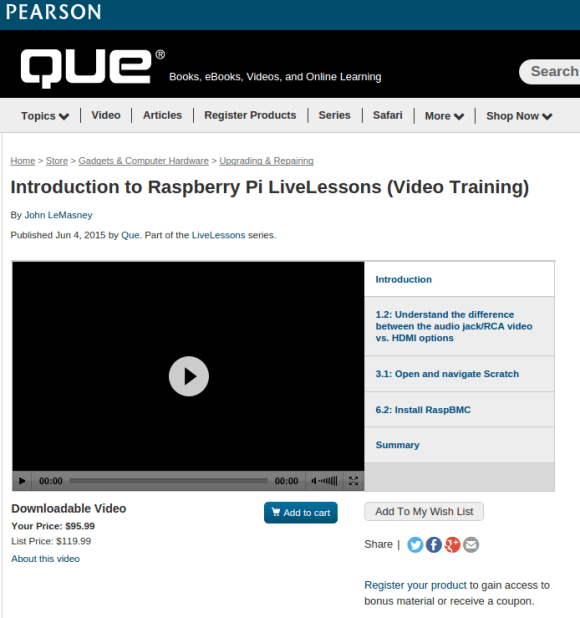
Introduction to Raspberry Pi LiveLessons Video Training Que – http://goo.gl/dzID3i
I made some videos earlier this year.
I had the great pleasure earlier this year of working with Que Publishing to develop and release several video how to products about WordPress and Raspberry Pi. You can see some samples here: I really enjoyed the experience of walking to the studio in San Francisco. The air was so warm, and the food was so very good and fresh. It made it a joy to work in the studio and come out into the bright sunshine.
I loved it. It wasn’t until recently that I had an opportunity to reflect on my experience, and it was really healing. Thanks to Que and Pearson for the professionalism and gratitude that I was shown in that process. It was a delight to get to know all of you.
“John LeMasney is a designer, artist, writer, poet, technologist, consultant, open web advocate and open source evangelist. He is most interested in helping people to use technology to make their lives, work, and world better.” found in John LeMasney | Que at http://goo.gl/dzID3i
Libraries, the original co-working space cc-by lemasney
Libraries, the original co-working space cc-by lemasney
Explain like I’m 5: is this library meeting room policy a reasonable representation of librarianship?
(Some) policies exist in (some) NJ libraries that prevent a patron from walking in and requesting a room because of the content of the meeting, e.g. the meeting is for the purpose of conducting business (defined as the exchange of money for services).
Under this policy, co-working in the library, for instance, is prohibited.
The reason: “if we were to allow anyone in to use our facilities for any purpose, we would be overwhelmed and inundated with people who were not paying for the service. Small businesses should support themselves elsewhere”.
Agree, or disagree, and why?
Contingency case details
Public Library system, municipal, large facility with many (at least 10) open, observed as generally unused meeting rooms, all of which fit between 10-50 people. I am interested in other cases.
The conflict
I would go to this library out of mutual convenience for a quiet, neutral, clean space to work with an elderly client. I have been meeting at least twice a month for months there. Surreptitiously.
We would meet quietly, in one of the vast, empty general community spaces (e.g. gallery) on a bench, I was chased from the bench twice, so started meeting in the empty meeting rooms, from which I was chased to sign up for the room, because someone might see people in the room and assume there was a conflict with their room reservation.
I explained that in that case I would simply relocate to one of the other huge empty rooms without bothering staff or patrons with paperwork or a request. I got a rolling-eyes response. They have heard this before.
And then, I complied. Well, really, I just lied.
I gave in and went thorough the multipage form, presenting identification, reasoning and content for the meeting (meeting with a friend to discuss technology), and time required. I came away from the process with serious philosophical reservations about the policy. After several sign-ups, essentially a initial signature in subsequent visits, I still was confronted with questions and doubts about my intentions.
My generalized response was “What business is it of yours, exactly, what I talk about in a private meeting?” I was told that it was a policy driven series of questions, and that I should not be offended or concerned unless I am doing something wrong. I was very clear that I was not doing anything wrong, but still breaking policy.
Money is exchanged in the meeting for consulting work, the key element of dismissal of the request: e.g. no meetings for the purposes of business.
I argued that everyone in the library at the time is there for the purposes of productivity and that the exchange of money has little influence on the use. I am a member of the library essentially for this purpose, co-working. It is a long standing tradition, as I understand it, in libraries. Providing space to do work safely and quietly. I was told that those people were not requesting rooms. This is when I rolled my eyes.
There is no cafe there. There is a quietude policy cast over most of the floor. You walk into the 1970s upon entering. I am not saying this to disparage the library, but rather to give you a feel for the atmosphere. Lots of stacks, a few old PCs, no windows to speak of.
I go for the free wifi and the (fairly uncomfortable) chairs.
Those exist elsewhere, including other libraries (problem solved), but also in any cafe, fast food restaurant, bookstore, many parking lots, and of course, at my office. However, those are not neutral, freely available spaces. Neutrality is a gift of libraries.
At the predictive idea that those interested in the use of the library for business could easily go to a McDonalds and get exactly the same service (or demonstrably better) without signatures and with cheap coffee, I was told by the director to go do that.
And so, I will. In particular, I will quickly go to other libraries as i do now in order to have these kinds of meetings.
Librarians, please explain like I’m 5. Am I overreacting, or is this a part of the death of libraries?
“After a few weeks off, John LeMasney and Brian Kelley return for another episode of Technology and the Arts, as they continue to take you behind the scenes of the creative process of a collaborative music project. Watch live starting at around 10:20 pm ET on Thursday, Oct. 22, 2015.” found in Technology and the Arts – Ep. 78 (10.22.2015) – YouTube at
In this episode, John and Brian talk about updates in local arts, their adventures with Ardour, and their new plan to start bringing ideas together for the collaborative song project.
Sweetgum Seed lamp (detail), steel, glass, and LEDs, Robert Kuster and John LeMasney, 2015
There’s a lot going on now at LeMasney Consulting!
Teaching
John LeMasney teaching
Teaching at area schools and libraries has started up again! I’m at Rider University, Princeton Adult School, Princeton Public Library and other great venues and old friends like Cherry Hill Public Library. I’m talking about visual literacy, graphic design, personal branding, Arduino & Raspberry Pi, the Internet of Things, and lots of other fun topics. You can see all of my public events on the calendar in the sidebar or menu.
I’m doing a lot of WordPress work now in helping some local entrepreneurs get off the ground, developing branding campaigns, and strategizing about new avenues. A lot of people are really excited about one-page designs, but I’m not totally sold on their longevity. Call me and tell me your take on it.
I’m still very excited about the Photo Essay about Jedediah Higgins House though I’d love more people to see it. Have you checked it out yet? <blink> I’ve also been thinking alot about the social networking problem of chaos versus order, and how hashtags are a really great, open solution that many people are still confused about. Hashtags are an idea, simply, that collect other ideas. When I precede a word with a hash (#) it indicates that I am using it as a collector, group, or thread that leads to other content about that topic, because others have used that hashtag as well. I love WordPress in part because of how well it uses tags and categories as well as other metadata to prompt you to create a taxonomy (or folksonomy) of your content.
Art
Princeton Parklet Maple Seeds cc-by lemasney
The Princeton Parklet is coming down (today, in fact) and my seeds are coming down with it. I’m sad to see them go from the public view, but happy that two of them so far have been sold for $500 apiece! If you’d like one of these beautiful pieces, please contact me about their availability. We can make more!
In the meantime, we’ve continued the work with seeds, and here is a preview of the next seed, a sweetgum seed, those prickly balls that are underfoot all autumn long.
Sweetgum Seed lamp (detail), steel, glass, and LEDs, Robert Kuster and John LeMasney, 2015
TechArts is going to make a song, and share how they did it.
Technology and the Arts, my longest running podcast with the multi-talented Brian Kelley, is trying something different. We are making a song together, and sharing the process as we go. We are not sure what kind of song it will be, or what it will sound like. But we just recently locked down the tempo, agreeing on 80 BPM. We have also decided on Audiotool, the amazing cloud based EDM workstation. Some other details are revealed in the first two episodes of this season. all about making a song, collaboratively, remotely, and electronically.
Please watch below and subscribe on YouTube (links in the descriptions)!
“Streamed live on Sep 14, 2015 John LeMasney and Brian Kelley return for another season of Technology and the Arts – this time, they’ll take you behind the scenes of the creative process as they plan to collaborate on a music project.” found in Technology and the Arts – Ep. 75 (9.14.2015) – YouTube at https://goo.gl/92IdeF
“Streamed live on Sep 23, 2015 John LeMasney and Brian Kelley return for another episode of Technology and the Arts, as they continue to take you behind the scenes of the creative process of a collaborative music project.” found in Technology and the Arts – Ep. 76 (9.23.2015) – YouTube at https://goo.gl/v16Fwn
Of particular interest in episode 76 is a very brief overview of Audiotool, Audacity, and Drumbit, the tools we will be using to make our song.